
Mortgage Questions, Made Clear
-
Buying a home isn’t just about qualifying. It’s about knowing you’re ready.
Most people start with “How much can I afford?” But the better first question is: “Am I ready to take this on, financially, emotionally, and logistically?”
You don’t need perfect credit or a 20% down payment. But you do need a good handle on a few key things. Let’s walk through them.
1. Do You Have Stable Income and a Consistent Work History?
Most lenders look for:
2 years of steady income (W-2, 1099, or self-employed)
A reliable job or source of income expected to continue
That doesn’t mean you can’t buy a home if you’ve changed jobs recently. It just means we may need to explain that change and show your income is still solid.
2. Are You Comfortable With Your Monthly Expenses Now?
If your current rent stretches your budget, a mortgage might too. But if you’re saving every month or comfortably paying more than your target mortgage amount, you may already be in a better spot than you think.
We’ll help you figure out:
What your monthly payment could look like
What feels safe and manageable to you, not just what a computer says you qualify for
3. Do You Have Savings, Not Just for the Down Payment?
Most people focus on how much they need to buy. But it’s just as important to look at what happens after you move in.
You’ll want to budget for:
Property taxes
Homeowners insurance
Minor repairs or surprises (even in a new home)
Utility bills and moving expenses
Even a small emergency fund (a few months of expenses) can give you peace of mind when the water heater quits or tax season hits.
4. Are You Clear on Why You’re Buying?
This one’s big.
Are you buying because you:
Want stability?
Plan to stay for a few years?
Need space for kids, pets, work, or life?
Want out of the rent race?
There’s no “wrong” reason, but clarity helps shape the right loan structure. If you’re trying to flip the house in a year vs. live in it for 15, the strategy should reflect that.
Bottom line:
Being ready doesn’t mean having everything perfect. It means being honest with yourself about what you can handle, what you need, and where you want to go next.
If you're not sure how close you are, we can walk through it together.
-
“How much can I afford?” sounds like a simple question. But really, it has two different answers:
What the lender qualifies you for (based on math)
What you actually feel comfortable spending (based on real life)
They don’t always match, and the second one matters more.
1. What the Lender Qualifies - Using our SLEAP Method
At Francis Mortgage Team we use something we call the SLEAP Method to understand your loan picture:
Score - your credit profile
Liabilities - monthly debt payments on your credit report
Employment (income)
Assets - what you’ve saved
Property - the home you’re buying
These five areas help us figure out what you qualify for, and just as important, where we can make improvements.
For example, if your household income is at 100% of the Area Median Income (AMI) for Denver-Aurora (~$126,090/year, or $10,507/month), a lender might approve you for monthly debts up to 45% of that, roughly $4,728/month on things like your mortgage, auto loan, and student loans combined.
That’s what’s possible. But now we need to look at what’s practical.
2. The Comfort Answer - and Today's Reality
In an ideal world, buyers feel completely at ease with their mortgage payment. But in many places, buyers are stretching more than they’d like just to own something.
That’s not failure. That’s the market. What matters is being smart about how far you’re willing to stretch, and making sure your choices don’t add long-term stress.
We’ll talk through:
How much payment still allows you to save, invest, or breathe
What sacrifices feel manageable, and which don’t
Whether buying now vs. later or co-buying makes more sense
There's no perfect number. But together, we can map out your range and make sure you move forward with clarity, not pressure.
3. Don’t Forget the Real Monthly Costs
Some lenders will only quote you the base loan payment, principal and interest, to make the monthly number look lower. But that’s not the full story.
We believe in transparency. That means showing you the total cost so there are no surprises later. Your monthly payment often includes:
Principal & interest - the loan itself
Property taxes - depends on the county
Homeowners insurance
HOA dues - if applicable
Mortgage insurance - if your down payment is under 20%
We include all of it from the start. That’s how you make smart decisions, with the full picture, not just part of it.
Bottom Line:
We’ll help you understand what you qualify for, what feels manageable, and what’s actually involved in the monthly cost, so you don’t get caught off guard later.
That’s the difference between guessing and being ready. Let’s build your plan together.
-
Not all home loans are created equal. And not every borrower fits neatly into the same box.
That’s why the very first question we ask is: “What are you trying to accomplish?”
Whether it’s your first home, a second home, an investment property, or a refinance, the right loan depends on your goals, not just the lowest rate.
The Five Core Loan Types
Most borrowers fall into one of these five:
Conventional: The standard for most qualified borrowers. Great for buyers with strong credit, stable income, and at least 3-5% down.
FHA: More flexible credit requirements and down payments (as low as 3.5%). Often used by first-time buyers or those rebuilding credit.
VA: For eligible veterans and active-duty military. No down payment, no mortgage insurance, and extremely competitive rates.
USDA: For homes in eligible rural areas. 0% down, income limits apply. A great option if your home qualifies geographically.
Jumbo: For loan amounts above the conforming limit. Higher qualifying standards, but sometimes better pricing for strong borrowers.
We’ll help you compare these side by side, rates, costs, and long-term pros and cons, based on what you’re trying to accomplish.
What if You Don’t Fit the Standard Boxes?
We work with a lot of great borrowers who don’t check the usual boxes. That’s where non-conforming loans come in, also called “non-QM” (non-qualified mortgage).
Examples:
DSCR (Debt-Service Coverage Ratio): For investors, approval is based on rental income, not personal income.
Bank Statement Loans: For self-employed buyers who don’t show all their income on tax returns.
Asset Depletion: For retirees or high-net-worth clients who don’t have a monthly paycheck, but do have savings or investments.
Stated-Income / Alt-Doc Loans: Available in specific situations where documentation flexibility is needed.
We’ll always start by checking if a traditional loan works. But if it doesn’t, we have other routes. The goal is never to force the borrower into the loan, it’s to fit the loan to the borrower.
Bottom Line:
There’s no “best” loan in a vacuum. What matters is which one fits your goals, your timeline, and your long-term financial picture.
If you’re not sure where to start, that’s normal. We’ll walk you through the options, no pressure, no jargon, just clear comparisons so you can decide what’s best for you.
-
Before you buy a home, or refinance one, you’ll want to know: “How much cash do I need, and what’s my monthly payment?”
Most people expect a single number. But there’s a lot that goes into that number, and not all of it comes from your lender.
Let’s break it down clearly, so you know what’s real, and what’s flexible.
The Two Big Questions Every Quote Answers:
1. How much do I need to bring to closing?
2. What will my monthly payment be?
Everything in a mortgage quote fits under one of those two buckets. Here’s what makes them up:
What Affects Your Closing Costs?
This is the upfront cash you’ll need at the closing table. It typically includes:
Down payment - You choose this amount (usually 3% to 25%)
Lender fees - Application or underwriting (we’ll disclose if we charge any, many times we don’t)
Appraisal - Required to confirm home value (unless waived)
Credit report - Small fee to pull your credit
Title insurance - Protects your ownership; required by most lenders
Escrow/closing fee - Paid to the title company for handling funds
Recording fees - Charged by your county to record the deed
Some of these are negotiable, others aren’t. We’ll tell you who controls what.
What makes Up Your Monthly Payment?
There’s more than just your loan. A complete monthly payment typically includes:
Principal & interest - Based on your loan amount, rate, and term
Property taxes - Set by your county (we can’t change these)
Homeowners insurance - You choose your provider and policy
Mortgage insurance - If you put less than 20% down
HOA dues - If your home is in a managed community
This is why a quick online calculator usually falls short. They often leave out taxes, insurance, and MI, making things look cheaper than they really are.
Who Controls What?
You control: Down payment, loan type, homeowners insurance, closing date
The lender controls: Rate structure, origination fees (if any), and underwriting requirements
Third parties control: Title fees, county taxes, HOA dues, and appraisal costs
We’ll always break out who charges what, so there’s no mystery.
Bottom Line:
A mortgage quote isn’t just “rate and payment.” It’s a layered breakdown of what you’re buying, what you’re paying upfront, and what you’ll pay monthly.
We’ll walk you through it side by side, so you know exactly what’s real, what’s flexible, and what’s worth exploring further, no guesswork, no games.
-
The Truth About “Lowest Rates”
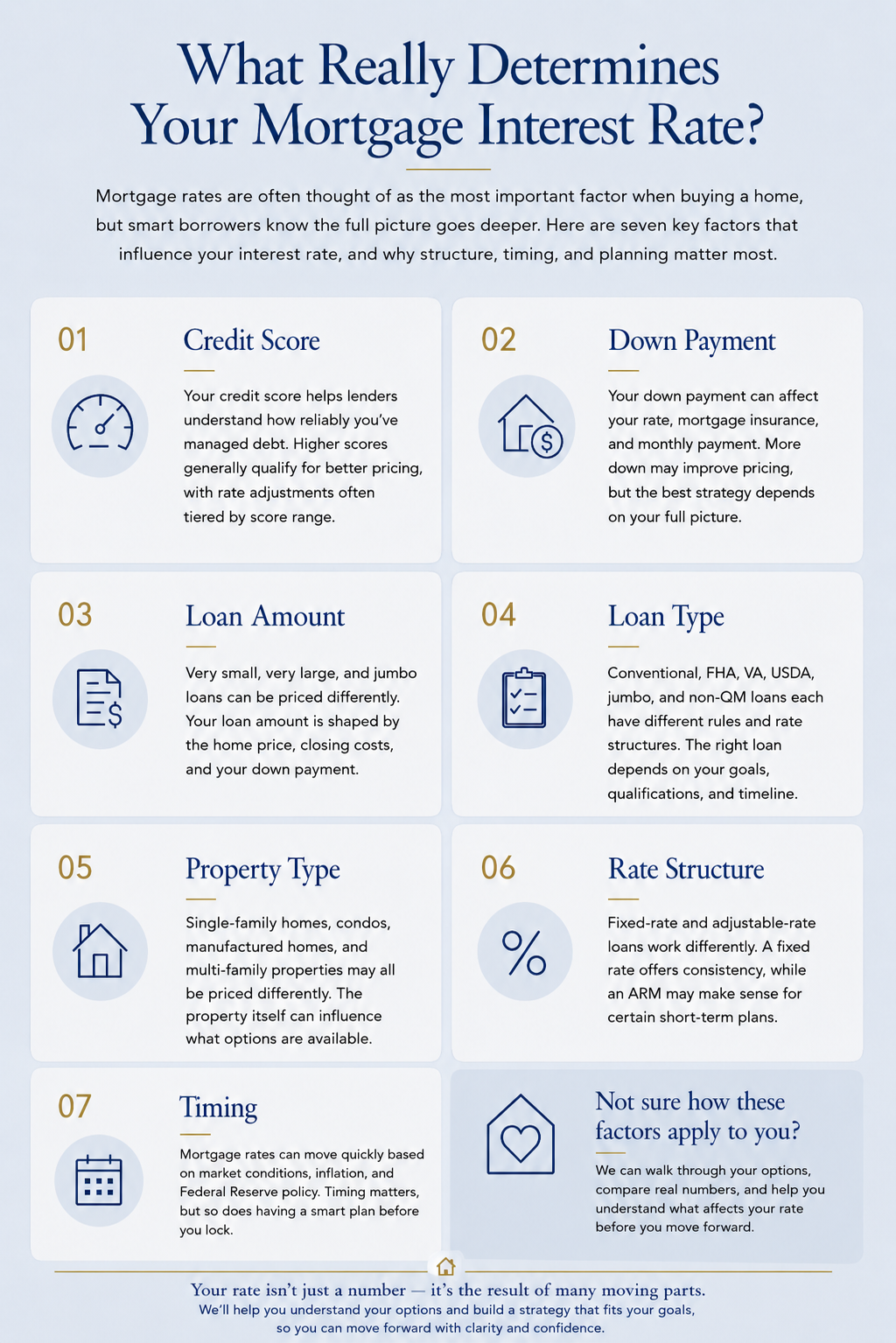
Mortgage rates are often seen as the most important factor when buying a home, but the full picture goes much deeper. Your rate can be influenced by credit, down payment, loan type, property type, timing, and overall loan structure. That’s why planning matters. Some lenders advertise super-low rates to get your attention, but the fine print may tell a different story:
The rate may include “points,” which are prepaid interest paid upfront.
The advertised rate may only apply to a very specific borrower profile.
The quote may leave out mortgage insurance, taxes, closing costs, or other fees.
The lowest-looking rate may not actually be the best long-term option.
We don’t play those games. We’ll show you the full cost, monthly, upfront, and long-term, so you can make an informed decision, not just a fast one. Bottom line - Your rate isn’t a number pulled off a shelf. It’s the result of real inputs, including some you can control. We’ll help you understand your options, and if there’s a way to get you better pricing without stretching your budget, we’ll find it.
When can I lock in my Rate?
Once you’re under contract on a home (or far enough along in a refinance), we can lock your rate to protect you from market swings. Rate locks come in different lengths, and we’ll walk through what’s smart based on your timeline.
Until then, we can watch trends together and keep you updated, no spam, just real-time updates if something moves.

Ray Dalio’s classic 30‑minute animated explanation of how credit, productivity, and debt cycles power the economy—and why it matters for your mortgage strategy.